Receive posts by email

Thursday, 29 October 2015

Inquiry Update: Movie Making Week 4

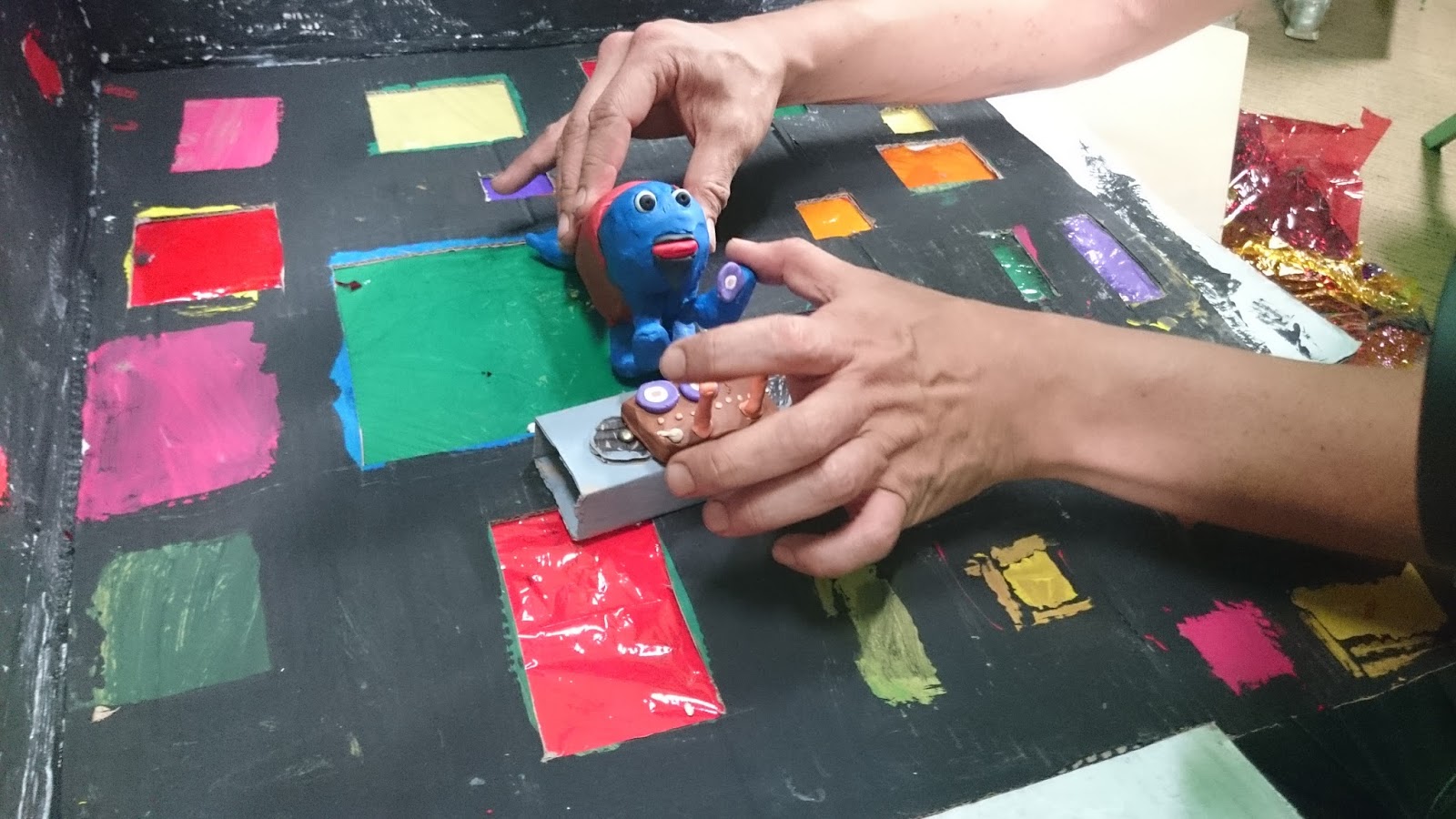
This week we are well into the filming of our movies. The movie group have been broken up into 4 subgroups and have been exploring four different part of the movie making in rotation. The students have been helping with the documenting of the process of making the movie through photographing and filming and we have also ran workshops to investigate interview techniques, focusing on asking open and closed questions. We would like to thank Ian (Finn's dad) for coming in and helping us pout during the filming.

We have made full use of the media space and now using the green screen.

Some students are exploring making the music for some of the scenes.

We have ran workshops exploring different interview questions for the 'Making of..." documentary.

Students try out their 'open' questions to each other.

Wednesday, 28 October 2015

Home Learning - Spelling

Spelling Strategies:
Use of Sounds and Spelling Patterns

Young writers often try to use the sounds in words to figure out their spellings; experienced writers often use this phonetic strategy first, and then try other approaches, including applying common spelling patterns. So it is definitely worthwhile to help children hear the sounds in words by developing phonemic awareness, and then exploring sound/symbol relationships and spelling patterns. The following strategies are used at school to support children with spelling. You may wish to try some of them at home.

Strategy 1: Develop Phonemic Awareness
  • Children develop the ability to hear sounds in words when they are involved in lots of reading of poems, chants, songs, and books with repetitive refrains and rhyme. Ask children to listen for and identify rhyming words, e.g. clap when they hear them.
  • Select words children know — from books, rhymes, songs, and so on — and discover together how knowing one word can help with the recognition or writing of others, just by changing the beginning letter(s). For example, when reading the chant "Mary Mack" write the words Mack, black, back, crack, quack on a chart. Invite children to suggest other words with the same sound: pack, sack, whack, track.

Strategy 2: Explore Sounds
  • Children are reminded to listen for sounds in words they are trying to write. They are supported with sound/letter recognition when familiar books, rhymes, chants, and songs are re-read and they are asked to listen for words with a particular sound. These can be listed on a chart; for example, words with a /k/ sound: kite, cat, school, bike, Christine, truck, cake, back.
  • Help children to identify the letter(s) that represent this sound. Underline these and ask children to group the words according to the different ways the sound is represented. For example:
kite, bike, cake
cat, cake
school, Christine
truck, back
Reinforce how the same sound may be represented in more than one way, depending on the word.
  • Children can find other words they know with this sound and add them to the list. Explain that you must say a word to listen for the sound, and do not confuse them by referring to the sound by a particular letter name.


Strategy 3: Discover Spelling Patterns
  • Children are told that thinking about what a word looks like is a useful spelling strategy. Explore some common spelling patterns together. Reread a familiar book, poem, or so on, selecting a particular spelling pattern to look for. For example, look for and list words with ea, such as: bead, bread, dead, instead, great, read, treat, break.
  • Ask children to identify and underline the ea spelling pattern in each word, say the words, and group them according to their pronunciation, such as:
bead, read, treat
bread, dead, instead, read
great, break
Select one of the words and show how knowing it can help with the spelling of other words in that word family. For example, great: greater, greatest, greatly, or break: breaking, breaks. Ask children to try this with the other words you've found.
(Adapted from Spelling K-8 by Diane Snowball & Faye Bolton)

Anne O’Sullivan

Literacy Coach

Sunday, 25 October 2015

Attention: Odd Socks Needed


During inquiry the students have been re-telling cultural stories through making puppets and creating plays. The puppets are being made in various ways and one of the ways we would love to create puppets is through using socks. So if you have an odd sock or two that is looking for a new home, we would gladly welcome them to the Year 1 neighbourhood.
Thank you,
Year 1 Team


Inquiry Update: Cultural Stories

As part of our inquiry into 'Messages can be conveyed through stories', the children have been engaging in cultural stories. They have re-told and explored these stories through various forms, for example comic strips, story books and listening posts. The children have started exploring the cultural stories through plays. They have chosen which stories they would like to portray as a play and have been designated characters. They are now in the process of designing and creating masks of the characters they are portraying.  


Friday, 23 October 2015

Family Stories

As part of our inquiry into 'Messages can be conveyed through stories', the children have been asked to interview a family member about family histories or family stories.

The children formulated the following questions during our inquiry workshop to ask a family member.  The children can either write, record. create a photo board or draw pictures to represent their learning.

The children can choose any five of the following questions or they can write their own.

Where were you born?
What languages can you speak?
What family traditions do you have?
What is your favourite family celebration?
Can you tell me about a time when you were little?
Can you tell me about a time you were at school?
What was your favourite subject at school?
What was your favourite food when you were little?
Where is your favourite place to visit? and why?
Can you tell me a family story?


       Further information for parent and carers will be given to the children to take home on Monday afternoon.


Fruit Salad

Last week the children brought along to school a piece of fruit to make fruit salad.  We made fruit salad to promote healthy eating in relation to the work we have been doing with Life Education and also to continue to develop our writing of procedural texts.


Despite having two teachers away on Friday, we were overwhelmed by parent support that helped the morning run smoothly.  Thank you so much.


The children's recipes on how to making of fruit salad (procedural text).


Thursday, 22 October 2015

Inquiry Update: Movie Making Week 3

This week, the movie making group have been busy in the library and in the media room animating our four fabulous characters. We have also had numerous movie making workshops covering wide range of subjects from using Garageband to the use of part/part/whole strategies in addition and subtraction. We would like to say a big thank you to Andrea (Amory's mum) for coming in and helping us with the making of the sets and the props this week.

The students were asked to design the tractor (with a trailer) which the four characters will use to escape the encyclopedia.

As a part of the design, they needed to specify the measurements. They decided that overall, it will be 60cm long.

Students then explored the different measurements for each of the parts (tractor, link, trailer).

This became a whole group workshop on addition and subtraction using the part/part/whole strategy. This will be explored more explicitly during numeracy targets in week 4.


We were all excited to be using the media space.

Some rigging had to be constructed in order to make Spludge fly!

Hipster the DJ.

We also explored music making workshops using Garageband.

We are still exploring the possibilities of this complex software!

If you would like to come and help, we will be doing the majority of the filming on Tuesdays and Wednesdays between 12pm-2pm. Please speak to Tomo for further details.